At ARTeeth Dental Clinic we work with an Er:YAG dental laser, the LiteTouch. On this page I explain what I use it for in my own treatments, what my colleagues on the team use it for, and what a laser procedure feels like.
- An Er:YAG laser can work on both soft tissue, such as the gums, and the hard tissues of the tooth.
- I use it to uncover implants, treat peri-implantitis, prepare cavities for fillings and contour the gums.
- The periodontist on our team also uses it for crown lengthening, cleaning periodontal pockets and gum depigmentation.
- Laser procedures are generally less sensitive, and sometimes no anaesthetic is needed.
What is an Er:YAG laser?
An Er:YAG laser emits light with a wavelength of 2940 nm, which is absorbed very well by water and by hydroxyapatite, the mineral component of enamel, dentine and bone. This is why the same device can be used on both the gums and the teeth.
In the LiteTouch laser, the laser source is built into the handpiece, with no optical fibre, so it handles much like the usual instruments in the surgery.
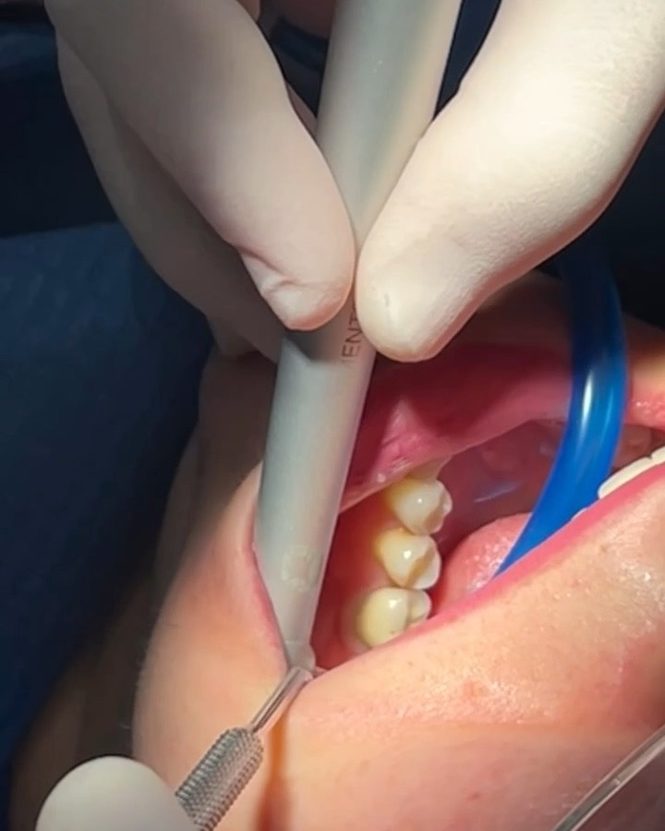
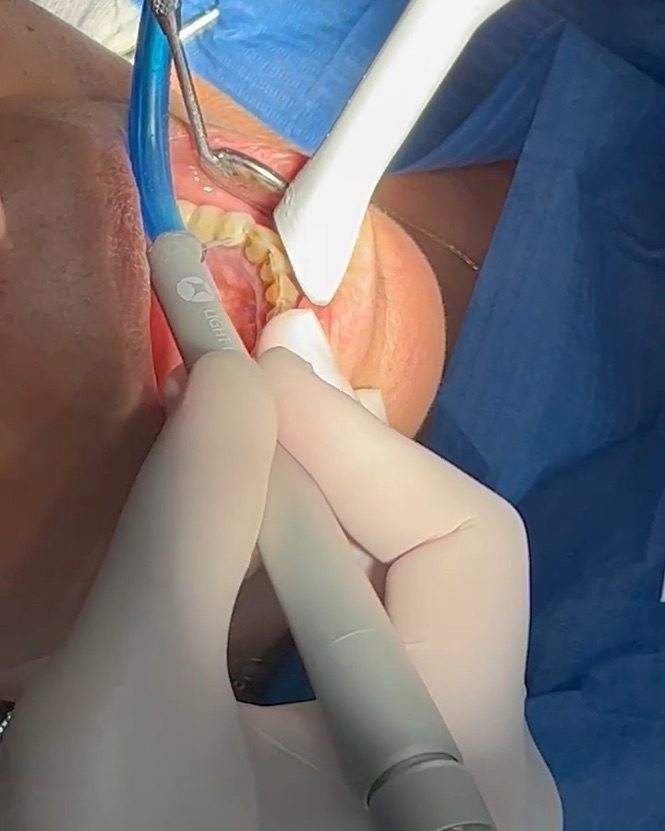
What I use the laser for
- Uncovering the implant. Once the implant has integrated into the bone, the gum over it has to be opened so that the healing abutment can be fitted. With the laser I remove only the tissue covering the implant. I describe the stages of treatment on the page about dental implants.
- Treating peri-implantitis. Peri-implantitis is inflammation of the tissues around an implant. The laser helps me clean and decontaminate the implant surface and the surrounding tissues.
- Preparing cavities for fillings. With the laser I remove the decayed tooth tissue before the filling.
- Gum contouring. I correct the outline of the gums, for example where it is uneven, for a more harmonious smile.
How my colleagues use it
The periodontist on the ARTeeth team uses the laser for:
- crown lengthening, when more of the tooth needs to sit above the gum line
- gum contouring
- cleaning periodontal pockets in the treatment of periodontitis. I wrote about this condition in the article on periodontitis.
- depigmentation, when the gums have darker areas
What the procedure feels like
Laser procedures are generally less sensitive, so in some cases no anaesthetic is needed. When the procedure requires it, we use a local anaesthetic. We discuss this before each treatment.
Frequently asked questions
Does laser treatment hurt?
Laser procedures are generally less sensitive, and sometimes no anaesthetic is needed. When it is necessary, we use a local anaesthetic.
Which laser do you use?
An Er:YAG dental laser, the LiteTouch, which can work on both the gums and the teeth.
Who carries out laser treatments?
I use it to uncover implants, treat peri-implantitis, prepare cavities for fillings and contour the gums. The periodontist on our team uses it for crown lengthening, gum contouring, cleaning periodontal pockets and depigmentation.
Can peri-implantitis be treated with the laser?
Yes. I use the laser in the treatment of peri-implantitis to clean and decontaminate the implant surface and the surrounding tissues. The treatment plan is decided after the implant has been examined.
This page provides general information and does not replace a consultation and clinical examination. Treatment is recommended only after an individual assessment.

Dentist with over 20 years of practice dedicated to prosthodontics and dental aesthetics. Founder of ARTeeth Dental Clinic, Bucharest.
At your consultation I examine your teeth, your gums and, where relevant, your implants. I explain which treatment I recommend and whether it can be done with the laser.