Porcelain veneers are part of my work in prosthodontics and dental aesthetics at ARTeeth Dental Clinic in Bucharest. On this page I explain how I work, when I recommend veneers and, just as importantly, when I do not.
- Porcelain veneers are thin shells of ceramic bonded to the visible front of the teeth to change their colour, shape or proportions.
- I always work with digital scanning and a mock-up, so you can see the proposed shape before any tooth preparation.
- I photograph the teeth before treatment, at the try-in and after completion.
- I do not recommend veneers for badly damaged teeth, non-vital teeth, very intense discolouration or bruxism.
- If the main goal is to align the front teeth, I recommend orthodontic treatment first.
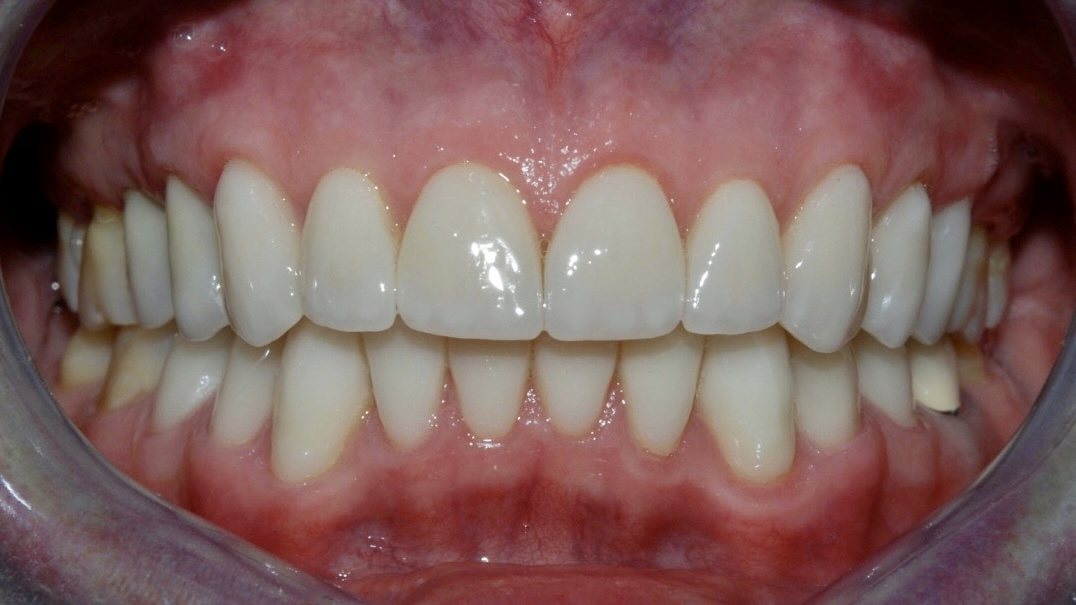
What are porcelain veneers?
A porcelain veneer is a thin shell of ceramic bonded to the front surface of a tooth. Veneers can correct the colour, shape, size or proportions of the front teeth while preserving as much of the natural tooth as possible.
The veneers I make are feldspathic porcelain, built up by hand by the ceramist, layer by layer. I explain this material and how it differs from others in the article on feldspathic porcelain veneers.
When do I recommend porcelain veneers?
- healthy teeth whose colour cannot be improved enough by whitening
- irregularly shaped, small or disproportionate teeth
- small gaps between the front teeth
- worn or chipped edges
- structural restoration of the teeth after orthodontic treatment, when still needed
The basic requirement is enough healthy enamel for the veneer to bond to, and healthy gums.
When do I not recommend veneers?
Veneers are not right for every situation. In my practice, I do not recommend them when:
- the teeth are badly damaged. A veneer covers only the visible front of the tooth and needs enough tooth structure to bond to.
- the teeth are non-vital, meaning they have had root canal treatment. These teeth are more fragile and may darken over time, and a thin veneer does not protect them enough.
- the discolouration is very intense. A thin veneer cannot fully mask a very dark tooth, and the colour underneath would show through the ceramic.
- the patient has bruxism, meaning they grind or clench their teeth. The high forces involved increase the risk of veneers cracking or coming loose.
What do I recommend instead?
The choice depends on the cause of the problem and on what the patient would like:
- Dental crowns, for badly damaged teeth, non-vital teeth or teeth with very intense discolouration. I describe them on the page about ceramic and zirconia crowns.
- Direct composite restorations, made in the surgery, where smaller corrections are needed.
- Orthodontic treatment, when the main goal is to align the front teeth. I prefer the teeth to be aligned first with orthodontics, with veneers used afterwards only if structural restoration is still needed. This preserves more of the natural tooth.
How I work, step by step
- Consultation and digital scan. I examine your teeth and gums, take the necessary X-rays and an intraoral scan. I do not use impression material, and the 3D model of your teeth appears directly on screen. I explain the procedure in the article on intraoral scanning.
- Initial photographs. I photograph your teeth and smile before any treatment. The photographs help me plan shape and colour and remain a reference point for the final result.
- The mock-up. A model of your future smile is made from the scan, and I transfer it onto your teeth as a temporary preview. You see the proposed shape in the mirror before any preparation, and we can make adjustments.
- Tooth preparation. Preparation is minimal and ideally stays within the enamel. The mock-up also acts as a guide, so that I remove only what is necessary.
- Making the veneers. The ceramist builds the veneers in feldspathic porcelain, layer by layer.
- Try-in, when needed. Before cementation, we check the shape and colour of the veneers on the teeth. I photograph this stage too, so that I can compare and, if needed, pass adjustments on to the technician.
- Cementation. The veneers are bonded with an adhesive technique. I then check the bite and photograph the final result.
- Regular check-ups. You return for a check a few weeks later, then for regular check-ups, usually every six months.
Photographing every stage is not a formality. It lets me compare the result with the starting situation and with what we planned together, and it shows you clearly what has changed.
How much of the tooth is removed?
Feldspathic porcelain veneers are very thin, usually around 0.3–0.5 mm, so preparation is minimal and ideally confined to the enamel. In some cases, for example when the teeth are small or set back, veneers can be placed with no preparation at all. Exactly how much is removed is decided from the mock-up, tooth by tooth.
How long do veneers last?
Long-term clinical studies report survival rates above 90% at 10 years for feldspathic porcelain veneers when they are bonded to enamel and properly maintained. Longevity depends on oral hygiene, regular check-ups and avoiding habits that overload the teeth. You will find more detail in the article on feldspathic veneers.
What affects the cost of treatment?
The cost is set after the consultation. It depends on the number of teeth treated, on any treatment needed before the veneers, such as professional cleaning, gum treatment or orthodontics, and on the complexity of the case. I present the treatment plan and the cost before we begin.
Frequently asked questions
Can I see what the veneers will look like before treatment?
Yes. With a mock-up, the proposed shape is transferred temporarily onto your teeth before any preparation, and we can make adjustments.
Can I have veneers if I grind my teeth?
I do not recommend veneers in cases of bruxism, because the high forces increase the risk of them cracking or coming loose. At your consultation we discuss which alternative suits your situation.
I have a tooth with root canal treatment. Can it have a veneer?
As a rule, no. Non-vital teeth are more fragile and may darken over time, so for them I usually recommend a crown.
Can veneers straighten crooked teeth?
If the main goal is alignment, I recommend orthodontic treatment first. After alignment, veneers are used only if structural restoration is still needed.
Is impression material used?
No. I work with intraoral scanning, so the impression is digital.
How many visits are needed?
It depends on the case. Usually a few visits over two to three weeks: the consultation and scan, the mock-up and tooth preparation, the try-in when needed, and cementation.
This page provides general information and does not replace a consultation and clinical examination. Treatment is recommended only after an individual assessment.

Dentist with over 20 years of practice dedicated to prosthodontics and dental aesthetics. Founder of ARTeeth Dental Clinic, Bucharest.
At your first consultation I examine your teeth and gums, take a digital scan and we talk about what you would like. If veneers are right for you, I explain the steps. If not, I tell you what I would recommend instead.